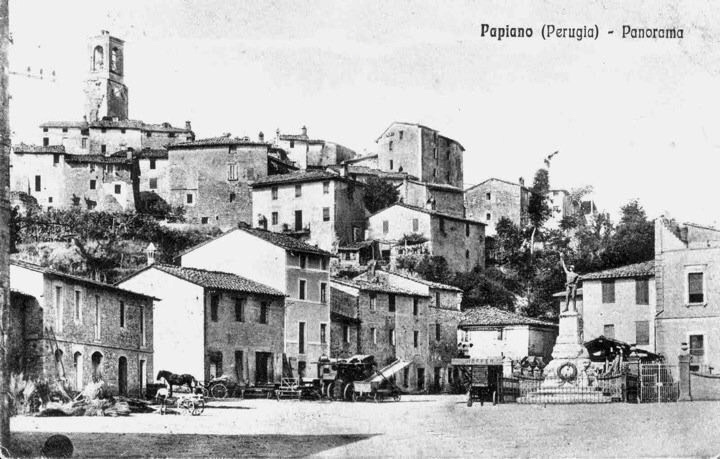
According to Felice Ciatti (a 17th century historian), the name may derive from the Papii, a cognomen of the Emilii, or from the Papinii, both families from the Roman era.
In the imperial diploma of Corrado II, of 1027, the town is named in reference to the church of San Silvestro, which fell within its jurisdiction.
The fortification of the village dates back to 1277 when, according to the Perugian historian Pompeo Pellini, Fra Bevignate was sent by the Podestà (chief civil magistrate) of Perugia to settle the dispute over where the new castle should be built. Its strategic location on the fertile plains of the Tiber River contributed to its development as a small agricultural settlement. During the Middle Ages, Umbria was characterized by fortified towns and villages, and Papiano was no exception. The village was surrounded by protective walls, with watchtowers and gates that are still visible today, reflecting its historical significance as a defensive stronghold.
It suffered several sackings: in 1311 by the imperial troops and in 1385 by the English leader Beltetto di Taddeo (John Beltoft). John Beltoft was a 14th-century English knight who served as a captain of men-at-arms in the papal army. In 1387, Pope Urban VI appointed him to oversee military expeditions in Tuscany and Umbria, to reclaim lands for the Church and suppress its enemies. His responsibilities encompassed organizing and leading military campaigns, ensuring discipline among troops, and maintaining the pope’s authority in the region. In 1416, it was occupied by Braccio da Montone. In 1428 it was assigned to the county of the Perugian Porta di San Pietro.
Two famous names from Papiano at this time were the medieval printer Francesco Cartolari, who lived in the 16th century, and the leader Simone da Papiano, who also fought in the battle of Lepanto (1571).
It was annexed to the Canton of Marsciano during the Napoleonic Republic and, with the Unification of Italy in 1860, remained under its jurisdiction.
Papiano was part of the Papal States for many centuries, experiencing the various political and social changes that swept through the Italian Peninsula. Throughout this period, the village maintained a predominantly agrarian economy, with local farmers cultivating crops such as olives, grapes, and wheat, which continue to be a significant part of the region’s economy today.
In the 19th century, with the unification of Italy, Papiano, like many other small Italian villages, experienced changes that led to a period of transformation and modernization. This included improvements in infrastructure and a gradual shift from a purely agricultural economy to one that embraced small-scale industries and crafts. Modern Papiano is a charming small village, not too far from the major towns such as Perugia, and well connected with the E45 to other regions of Italy.

 Welcome to Papiano, Umbria
You must be logged in to post a comment.